Classifications · 1 min read
Model classification
Classify completion, embedding, transcription and image models by where and how they run.
Each model type is classified separately, because each one touches your data in a different way. A completion model reasons over the text, an embedding model converts documents into searchable form, a transcription model listens to the audio.
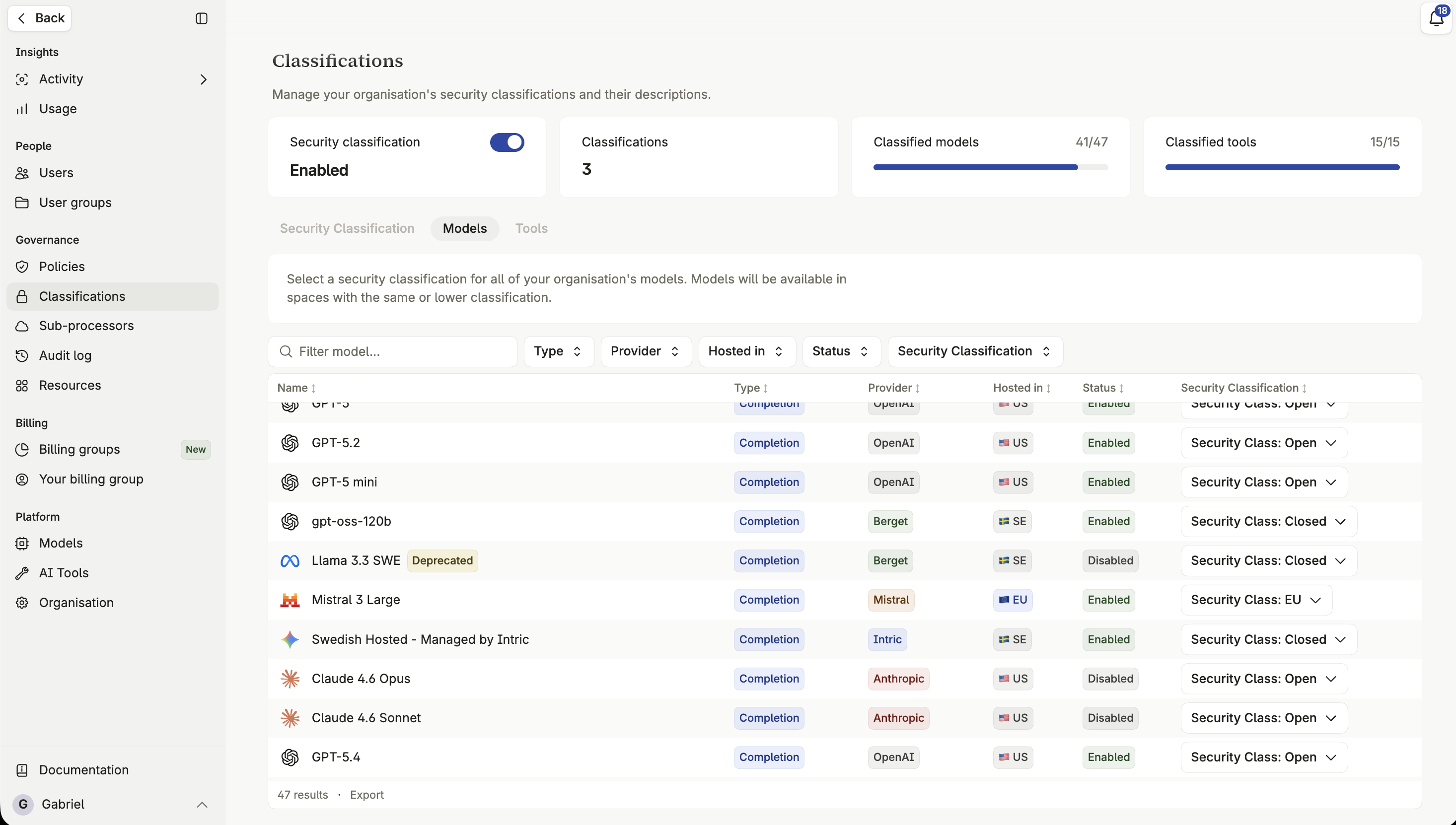
The model types
Section titled “The model types”Completion models
Section titled “Completion models”The “engine” that generates text and reasons over instructions. A powerful model hosted outside the EU might be classified low (Open), while a model hosted locally can be classified higher (Sensitive or Confidential). Thanks to inheritance, that local model also becomes available at the lower classifications automatically.
Embedding models
Section titled “Embedding models”Convert your documents into searchable vectors.
Transcription models
Section titled “Transcription models”Convert speech to text. If a recording contains sensitive information, its transcription model needs a classification to match.
Image models
Section titled “Image models”Generate and edit images from text descriptions.
Where a model runs, as well as how it’s classified
Section titled “Where a model runs, as well as how it’s classified”Classifying a model decides whether it’s appropriate for a given level of sensitivity. It doesn’t say anything about where the model physically runs — that’s the hosting region of its sub-processor, and it’s restricted separately by setting processing regions on the classification. A model can be classified correctly and still be unavailable because it runs outside the permitted regions. See Processing regions.
One embedding model per classification
Section titled “One embedding model per classification”Using the sub-processor column
Section titled “Using the sub-processor column”Each model’s row shows its sub-processor — the company that directly processes data when the model runs: the model vendor for an externally-hosted model, or Intric’s own infrastructure provider for a model Intric hosts itself. Use this column when reviewing your Data Processing Agreements or deciding which models are appropriate for a given classification.