System Architecture and Technical Overview
To carry out a proper DPIA you need to understand how the Intric platform works from a technical perspective. This article gives you the technical foundation you need to describe the system in your DPIA.
Overall architecture
Intric is a cloud-based AI platform that integrates several components to provide a secure and efficient environment for AI-assisted knowledge management.
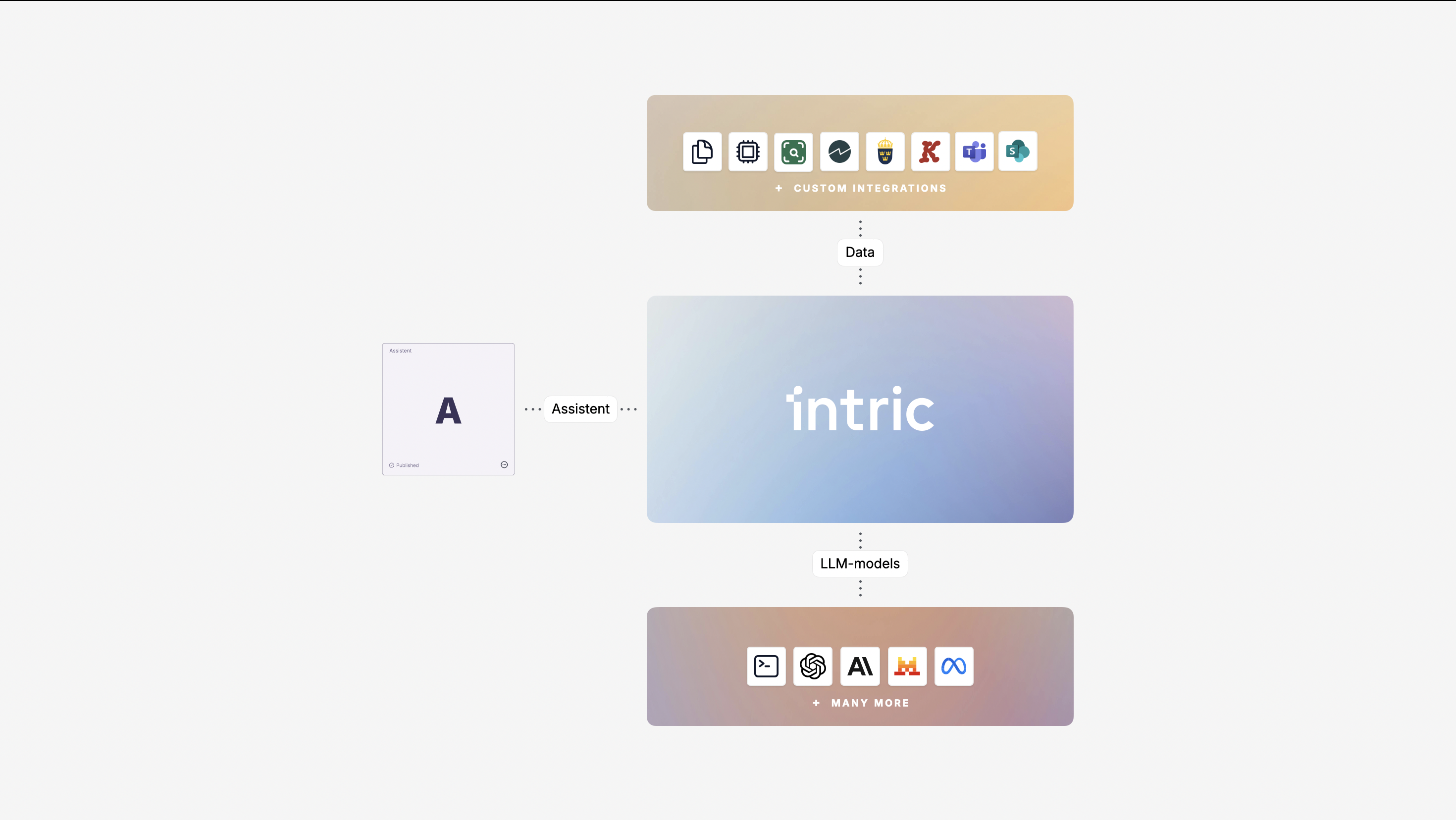
The platform consists of three main parts:
- The Intric platform – Where Assistants are created and users interact with them. The platform handles user authentication, document storage, permissions, and the user interface.
- Language models – Intric connects to various language models from different providers. The platform is model-agnostic, so you can choose which models to use based on your needs and security requirements.
- Connections to data sources – Via standards such as MCP (Model Context Protocol) and other integrations, Intric can connect to external data sources that users can interact with.
Within these three parts there are several important components:
- User management and authentication – Secure login via Single Sign-On (SSO)
- Document management and storage – Structured and secure storage of your organization’s documents and Knowledge
- AI processing – Integration with various language models for different purposes and security levels
- Sub-processors – External service providers that support the platform’s functionality
Below is a short description of each component with links to more detailed documentation.
User management and authentication (SSO integration)
Intric integrates with your existing identity solution to ensure secure and controlled access to the platform. With Single Sign-On (SSO), users sign in with their existing work accounts and do not need separate passwords.
Key points:
- Centralized permission management via your Identity Provider (IdP)
- Support for common SSO protocols (SAML, OAuth)
- Automatic user provisioning and deprovisioning
- Group-based access control
Document management and storage structure
Intric manages your documents and knowledge bases in a structured way through a system of Spaces (workspaces) and Collections. This supports both sharing of knowledge and clear separation between different levels of information.
Key points:
- Hierarchical structure with Workspaces, Spaces, and Collections
- Role-based access control (RBAC) at different levels
- Secure file upload and storage
- Versioning and traceability
Link to document management and storage structure to follow.
AI processing and language models
Intric integrates with several language models from different providers. This gives you the flexibility to choose the right model for the right task and security level. Different models have different characteristics in terms of performance, cost, and where data is processed.
Key points:
- Multiple model options (OpenAI, Anthropic, Google, on-prem models, and others)
- Ability to restrict which models may be used for certain data
- Security classification of models
- Transparent information on where data is processed
For a detailed description of how data is handled when you use the platform, see the following data flow articles:
Sub-processors and the supplier chain
As a processor, Intric uses a number of sub-processors to deliver the service. For your DPIA it is important to know who they are, where they are located, and what type of data they process.
Key points:
- Full transparency about all sub-processors
- Information on processing location for each sub-processor
- Data Processing Agreement (DPA) with all sub-processors
- Process for approving new sub-processors